


- Stomach
- Sides
- Back
- Buttocks
- Thighs
- and the overall body silhouette are rarely affected independently of one another.
- Instability of the flanks
- Sagging buttocks
- Excess tissue on the back
- or uneven transitions between the waist, hips and thighs.
For Dr Wiedner and Dr Richter, a body lift is not about achieving maximum tightening.
It is about restoring the functional and aesthetic unity of the entire body.
The body changes in three dimensions
Significant weight loss affects more than just the skin.
It also:
- Tissue quality
- Tension patterns
- Lymphatic system
- Fat distribution
- Muscle balance
- and the overall posture of the body’s silhouette are all affected.
Despite enormous personal effort, many patients feel that their bodies have not fully returned to their pre-pregnancy state biologically.
Excess skin, soft tissue and sagging contours often mean that the body’s silhouette no longer appears harmonious, even when weight remains stable.
This is precisely why Dr Wiedner and Dr Richter always view the body in three dimensions.
The focus is not on individual areas, but on the overall silhouette and the transitions between them.
Long scars versus long-term harmony
At the same time, a body lift is one of those procedures where it is particularly important to discuss scarring openly and honestly.
This is because the circular tightening technique deliberately creates a long, circumferential scar.
It is precisely for this reason that the decision to proceed is made with great care.
The procedure is particularly suitable for patients:
- following significant weight loss
- with pronounced skin laxity
- where there is marked weakness of the connective tissue
- or where there is widespread instability of the entire core.
From the perspective of Dr Wiedner and Dr Richter, however, it is never a question of achieving maximum tightening at any cost.
What is far more important is carefully weighing up the following:
- Scars
- Function
- Tissue quality
- Stability
- Mobility
- and long-term harmony of the overall body silhouette.
It is precisely in this that they see the crucial difference between aggressive body contouring and reconstructive body surgery, which makes sense in the long term.
The Lockwood philosophy and its further development
Dr Richter is one of the early pioneers of the Ted Lockwood body lift technique in Germany.
As early as 1999, he became familiar with the original Lockwood concepts in the USA and began introducing and further developing these techniques in Germany at an early stage.
Since then, Dr Richter – and later, together with Dr Wiedner – has been working intensively on:
- Circular body contouring
- Tissue physiology
- Tension relationships
- Internal stabilisation
- Biological healing
- and long-term body contour quality following significant weight loss.
Both have experience gained from several thousand body-contouring procedures and have published numerous scientific papers, textbook chapters and delivered international lectures on these topics.
It is precisely this combined experience, spanning several decades, that plays a crucial role in complex body lift procedures.
Modern body lift surgery involves more than just removing skin
In the past, body contouring procedures often focused primarily on removing excess skin.
Today, Dr Wiedner and Dr Richter know that, in the long term, attractive results depend much more on:
- Internal stability
- Controlled stress distribution
- Tissue quality
- biological resilience
- and tissue-friendly healing.
This is precisely why modern techniques for reducing tension and cavities play a key role.
So-called progressive tension sutures are used to fix the tissue to deeper structures in a gradual and controlled manner.
This makes it possible to:
- Reduce voids
- Distribute stresses more evenly
- Minimise seromas
- and create smoother contours in the long term.
Particularly in the case of large-area circular skin tightening, Dr Wiedner and Dr Richter regard these techniques as crucial for:
- Healing
- Comfort
- Stability
- and long-term shape retention.
The lower body lift – more than just a tummy tuck
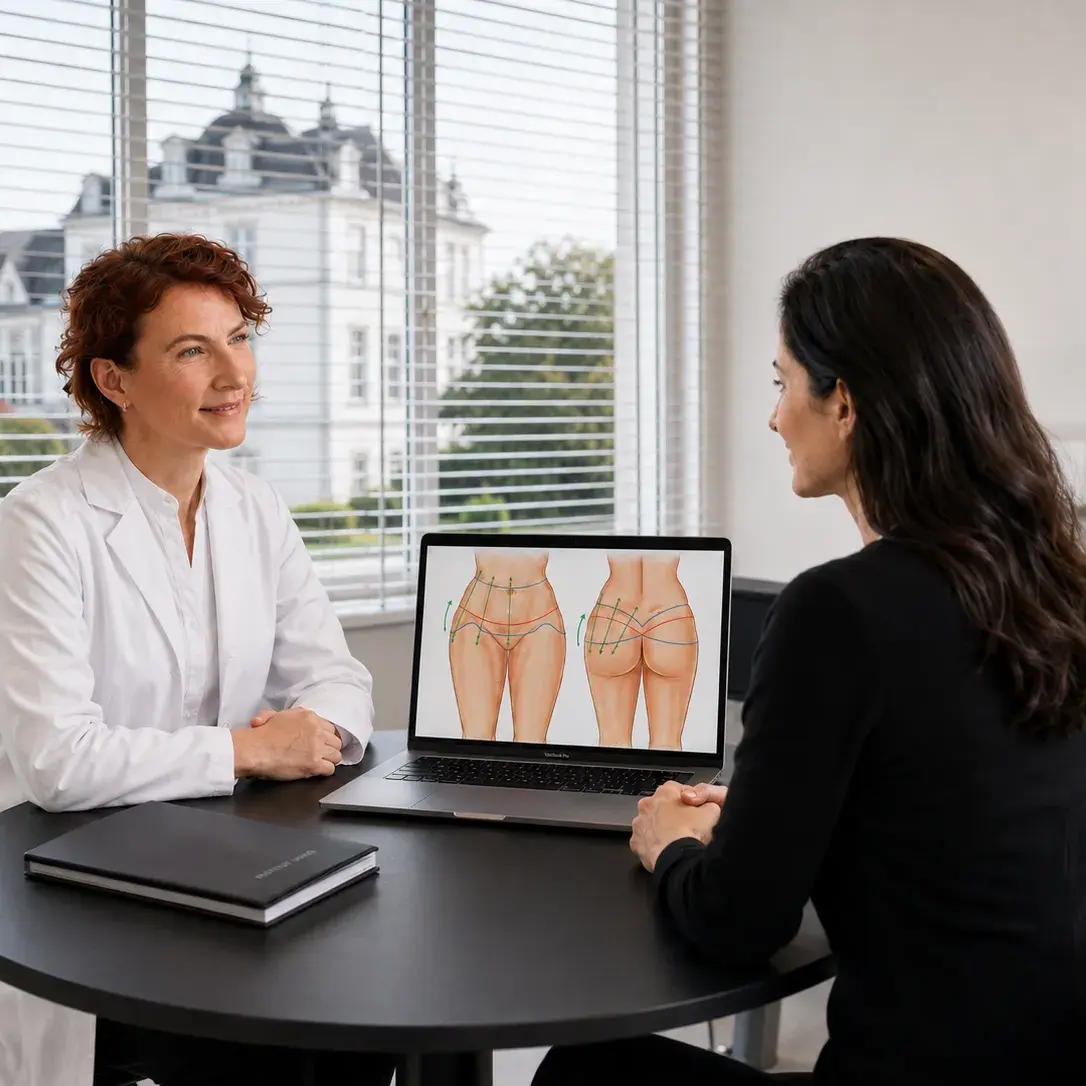
A particularly important component of modern circular body contouring is what is known as the lower body lift.
Whilst the classic body lift refers to the entire circular body silhouette, the lower body lift focuses primarily on:
- Abdomen
- Flanks
- Lower back
- Buttocks
- and the areas where these meet the hips and thighs.
It is precisely this area that often undergoes particularly noticeable changes following significant weight loss.
If only the anterior abdominal wall is treated, it is not uncommon for the following to remain:
- Sagging buttocks
- Excess tissue on the flanks
- Instability in the lower back
- or a lack of definition at the waist.
The lower body lift therefore takes a much more comprehensive approach.
It not only tightens the abdominal area, but also, at the same time:
- Defining the waist
- Firming the flanks
- Lifting sagging buttocks
- and smoothing the transition to the thighs.
It is precisely this holistic approach that often results in significantly more balanced and natural body proportions than isolated individual procedures.
For Dr Wiedner and Dr Richter, it is particularly important that the tension is not shifted solely to the anterior abdominal wall.
Rather, the entire silhouette should be reorganised evenly and in a way that is anatomically sound.
This often results in:
- Better dimensional stability
- More harmonious contours
- Smoother transitions
- and more consistent results over the long term.
The upper body lift – that is, the additional treatment of the back, chest, sides of the chest and upper body – is, by contrast, a complex procedure in its own right, which must be planned and assessed separately.
This may be particularly beneficial in cases where there is significant excess skin across the entire upper body.
Selected cosmetic cases at the UNIQ Institute
Whilst in the past, hospitals frequently treated severely obese high-risk patients, the focus at the UNIQ Institute today is deliberately on selected cosmetic cases.
This enables:
- Tailored planning
- Tissue-preserving techniques
- Regenerative approaches
- and the combined surgical expertise of both surgeons are utilised in a targeted manner.
This approach often leads to excellent, long-lasting results, particularly in patients whose weight is stable and who are in good general health.
The body as a functional and aesthetic whole
A modern body lift is never just about the tummy.
The overall body contour is always the key factor:
- Waist
- Flanks
- Back
- Buttocks
- Transitions to the thighs
- and the overall tension of the silhouette.
It is precisely for this reason that body lift approaches are often associated with:
- Liposuction
- Body contouring
- Regenerative procedures
- or autologous tissue techniques.
After all, a truly harmonious result is often only achieved when:
- Transitions
- Tension relationships
- Volume distributions
- and body proportions are treated as a single unit.
A natural look rather than maximum firmness
Dr Wiedner and Dr Richter deliberately adopt a gentle, anatomically-oriented approach.
Their aim is not to achieve maximum tightening or an artificial body shape.
Instead, the focus is on:
- Long-term stability
- Flexibility
- Fabric quality
- Harmonious proportions
- and a silhouette that feels natural and balanced.
In her view, the most challenging aspect of modern body lift surgery is not achieving the most dramatic transformation.
It lies in restoring tissue, function and body image to a stable, long-term balance.