



- dry and irritated eyes
- A feeling of pressure behind the eye
- Light sensitivity
- Double images
- Difficulty closing the eyelids
- or, in severe cases, even damage to the optic nerve.
It is precisely this combination of functional impairment and visible changes that makes the condition particularly emotionally difficult for many sufferers.
For Dr Richter, therefore, the focus is not solely on repositioning the eye.
His aim is to restore balance between function, protection of the eye, eyelid mechanics and natural facial expression.
What happens behind the scenes
Endocrine orbitopathy is an inflammatory autoimmune disorder affecting the eye socket. It often occurs in association with Graves’ disease.
In this condition, the tissue behind the eye undergoes changes.
The fatty tissue within the eye socket may increase abnormally, the eye muscles may swell or thicken, and as the condition progresses, inflammation, fluid retention and scarring may develop.
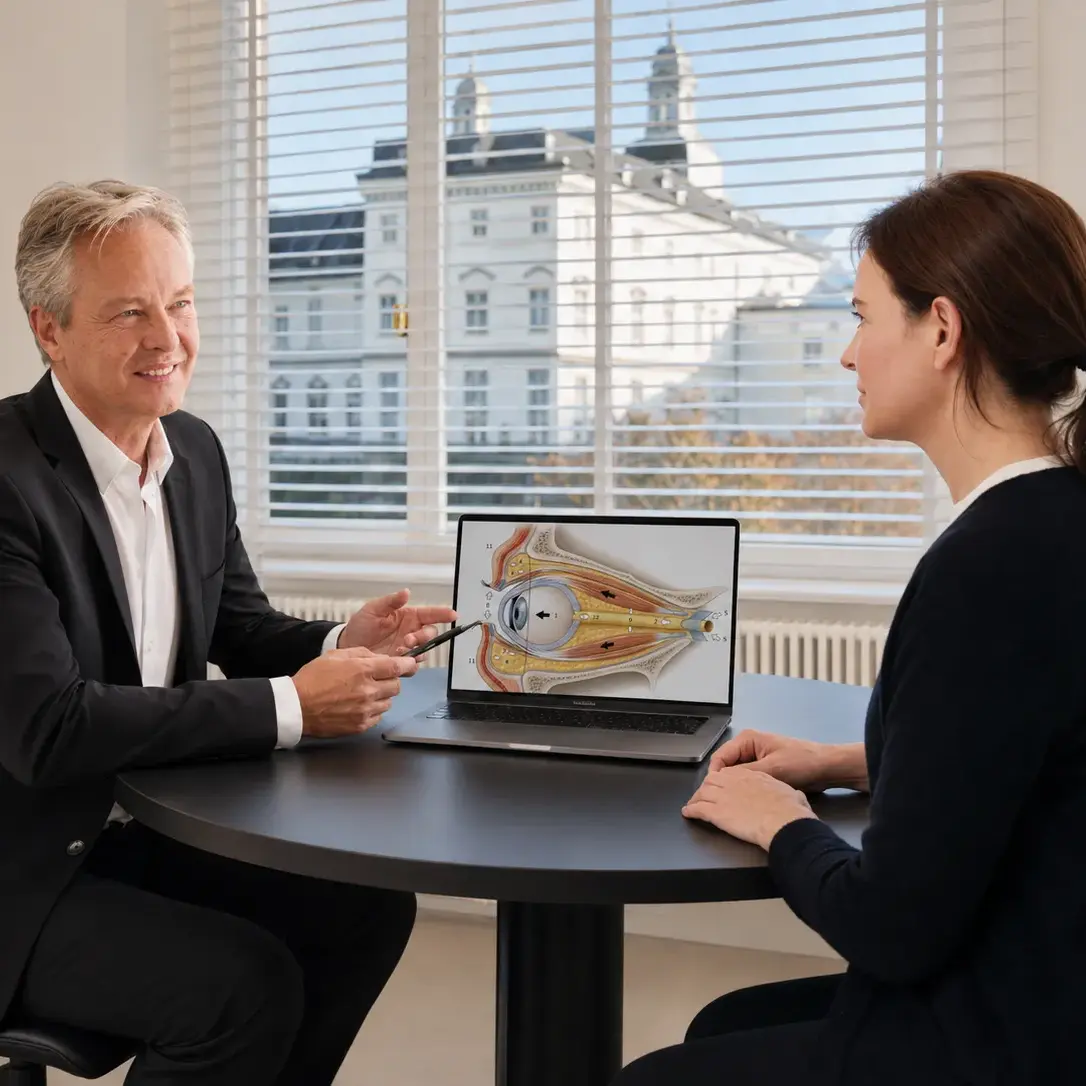
As the eye socket is a bony cavity, there is only limited space available.
The excess tissue creates pressure within the orbit. The eye is pushed forward – a condition known as exophthalmos.
At the same time, the eyelids often change as well.
The eyes appear more wide-open, fixed or startled. The upper and lower eyelids may recede, revealing more of the white of the eye.
It is precisely these changes that patients often find particularly distressing.
Not every protruding eye is a sign of Graves’ disease
An important part of the diagnostic process is accurately identifying the cause.
After all, not every case of protruding eyes is caused by endocrine orbitopathy.
Also:
- severe short-sightedness
- Vascular malformations
- Tumours of the eye socket
- inflammatory conditions
- skeletal asymmetries
- or specific fat distributions
- may appear similar on the surface.
Findings that are particularly one-sided or unusual clinical courses therefore require very careful investigation.
For Dr Richter, effective treatment does not begin with surgery, but with a precise understanding of the underlying anatomy and the nature of the condition.
Why the anatomy of the eye socket is so complex
The eye socket is one of the most sensitive and complex parts of the body.
Crammed into a very small space there are:
- optic nerve
- Eye muscles
- Blood vessels
- Nerves
- adipose tissue
- lacrimal gland
- as well as the supporting structures of the eyelids.
Even the slightest changes can have a significant impact on function.
Surgery in this area therefore affects not only the position of the eye, but also:
- Double images
- Eyelid position
- Eyelid closure
- Tear film
- Corneal protection
- and the overall appearance of the eye area.
This is precisely why Dr Richter does not view orbital surgery as a purely technical procedure.
In his view, it requires, above all, experience, an understanding of anatomy and a very keen sense of functional and aesthetic balance.
A personal connection to the Olivari technique
Dr Richter received his training in transpalpebral orbital surgery directly from Prof. Neven Olivari.
He learnt the technique of transpalpebral orbital decompression directly from him.
Dr Richter later took over the department from Prof. Olivari and continued to lead it as consultant for more than twenty years. During this time, he continually refined techniques for oculoplastic and transpalpebral decompression.
The experience gained from several thousand procedures on patients with endocrine orbitopathy has shaped his entire philosophy of eyelid surgery and aesthetics.
The following became particularly important to him:
• Minimally invasive approaches
• Respect for delicate anatomy
• Avoiding unnecessary trauma
• and striking a balance between function and aesthetics.
It is precisely his work in this sensitive area that continues to influence his aesthetic eyelid and facial surgery to this day.z
The importance of a precise analysis
A very thorough examination is carried out before every orbital decompression procedure.
What matters is not simply how far the eye protrudes, but why it protrudes and which structures are involved.
Among other things, Dr Richter assesses:
- the severity of exophthalmos
- the severity and duration of the illness
- the involvement of adipose tissue and eye muscles
- the position of the eyelid
- the closing of the eyelids
- the condition of the cornea
- the tear film
- eye muscle balance
- as well as the presence of double vision.
Previous operations, radiotherapy or significant scarring also play an important role.
This is because not every patient requires the same surgical approach.
In his view, the real skill lies in choosing the right strategy for each individual’s anatomy and the specific form of the disease.
The principle of transpalpebral orbital decompression according to Olivari
Transpalpebral orbital decompression according to Olivari takes a fundamentally different approach to many conventional bony decompression procedures.
Access is via the eyelids.
This often makes it possible to avoid major external incisions on the face or skull.
The key principle of this technique is the targeted removal of abnormally proliferated fatty tissue behind the eye.
In many mild to moderate forms of endocrine orbitopathy in particular, this fatty tissue is a major factor in the eye being pushed forward.
Removing the excess tissue creates more space within the orbit. The eye can move back into position and the pressure is relieved.
The key difference is this:
It is not just a matter of creating space – the diseased tissue itself is removed.
Difference from bony orbital decompression
In traditional bony orbital decompression surgery, parts of the bony eye socket are removed to allow tissue to spread into adjacent spaces.
This may be necessary and advisable in severe or muscle-related cases.
Particularly in cases of severely enlarged eye muscles or very high exophthalmos scores, purely fat-based procedures are often insufficient.
However, surgical procedures are generally more invasive and can have a greater impact on the balance of the eye muscles.
This leads to a significant tendency towards the onset or worsening of double vision.
The Olivari technique therefore takes a more tissue-sparing approach:
The abnormally proliferated fatty tissue is removed directly, without unnecessarily altering the bony anatomy.
Permanent removal of diseased fatty tissue
A key advantage of fat-based orbital decompression is that the removed fat tissue does not usually regrow.
The reduction in volume achieved within the eye socket is therefore usually maintained in the long term.
At the same time, Dr Richter attaches particular importance to providing honest information.
Endocrine orbitopathy remains an immune-mediated disorder.
In rare cases, new inflammatory activity or further changes to the eyelids may occur even after a successful operation.
That is precisely why he does not view the treatment as a single operation, but as a long-term, comprehensive functional and aesthetic approach.
Who the Olivari technique is particularly suitable for
Transpalpebral fat-based orbital decompression is particularly suitable for:
- mild to moderate forms of the condition
- exophthalmos predominantly caused by fatty deposits
- lower Hertel values
- minimal scarring
- and proper eye muscle balance.
It is precisely in these situations that very natural, functional and aesthetic results can often be achieved.
At the same time, Dr Richter is fully aware of the limitations of the method.
In cases of:
- protruding eyes
- significantly thickened eye muscles
- significant scarring
- severe asymmetrical findings
- or complex pre-operative procedures
Additional or alternative bone decompression procedures may be necessary.
The focus is not on the method itself, but on finding the right solution for each individual.
Eyelid retraction – an often underestimated aspect of the condition
A particularly important feature of endocrine orbitopathy is the change in eyelid position.
Many patients suffer not only from protruding eyes, but also from eyelids that are too wide open.
In upper eyelid retraction, the upper eyelid sits too high. In lower eyelid retraction, the lower eyelid appears to be pulled downwards.
This results in more of the white of the eye being visible. The gaze often appears fixed, startled or unnaturally wide open.
These changes are not merely a cosmetic concern.
They can also cause functional problems, as they make it difficult to close the eyelids properly and the cornea is no longer adequately protected.
This is precisely why Dr Richter regards eyelid correction as a distinct and particularly demanding part of the treatment.
Treatment of eyelid retraction
Orbital decompression improves the position of the eye – but it does not automatically correct every eyelid malposition.
Eyelid retraction has its own mechanisms:
- changes in the tension of the eyelid structures
- Scarring
- Muscle changes
- inflammatory remodelling processes
- and long-term mechanical stress.
For this reason, the position of the eyelid must be analysed separately and often treated separately as well.
Depending on the findings, the following may be necessary:
- Relieving tension in the body
- Lower eyelid stabilisation
- Canthoplasty
- Mid-face lift
- or spacer grafts.
In complex cases in particular, several steps are often necessary.
For Dr Richter, this is not a shortcoming of the treatment, but rather a reflection of the complexity of the condition.
The aim always remains:
- more complete eyelid closure
- Protection of the cornea
- natural blinking function
- less drought
- a calmer outlook
- and a more harmonious eye area.
Form and function go hand in hand
In the past, the management of endocrine orbitopathy was often viewed almost exclusively from a functional perspective.
Today, thanks to decades of experience, Dr Richter understands just how crucial aesthetic rehabilitation is to the quality of life of those affected.
Many patients want not just ‘less protruding eyes’, but to regain facial expressions that reflect their personality.
That is why his planning involves more than just measurements down to the millimetre.
The key factors are:
- a tranquil view
- natural eyelid position
- complete eyelid closure
- Schutz der Hornhaut
- smooth transitions between the eyelid and cheek
- and a facial expression that doesn’t look like it’s had plastic surgery.
- Risks and liability
Like any complex surgical procedure, orbital decompression carries risks.
These include:
- Bleeding
- Swelling
- Sensory disturbances
- Asymmetries
- incomplete restocking
- Double images
- or, very rarely, visual disturbances.
This is precisely why accurate diagnosis, realistic assessment of indications and extensive experience in orbital surgery are crucial.
His personal approach
Dr Richter does not regard the treatment of endocrine orbitopathy as a standalone eye operation.
For him, it is a holistic concept that combines functionality and aesthetics.
Orbital decompression, eyelid position, eyelid closure, the midface and volume must be considered together.
His aim is not to be as aggressive as possible, but to achieve a solution that is anatomically sound, gentle on the tissue and stable in the long term.
After all, it is not just the repositioning of the eye that determines a good outcome.
The key is the ability to restore harmony between the eyes, eyelids and facial expressions.