


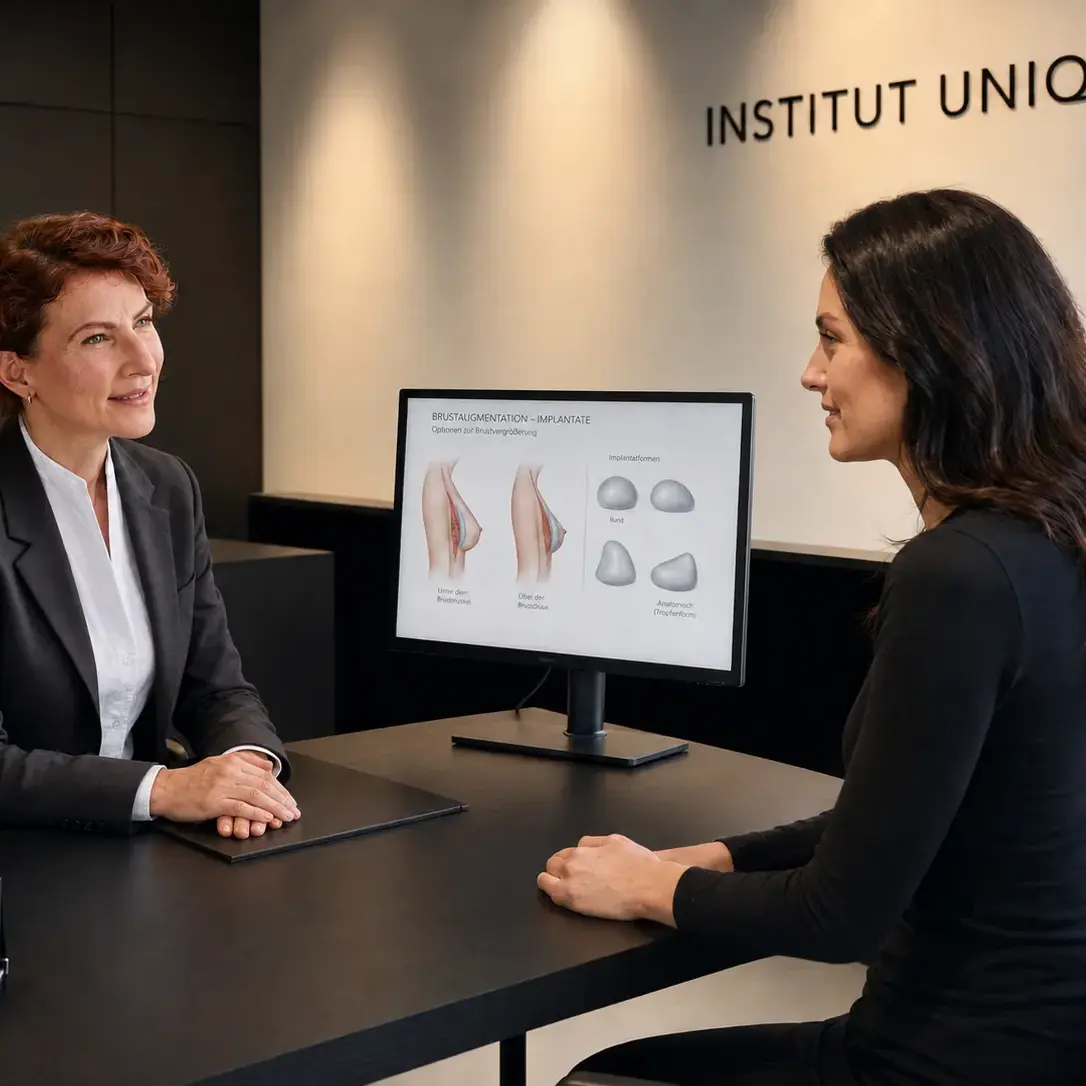
This is precisely why, for Dr Wiedner, a successful breast augmentation does not begin with the question:
“How large should the breasts be?”
But rather with the question:
What shape, what volume and what tissue load will truly suit the patient’s anatomy in the long term?
The breast as part of the whole body
A breast cannot be viewed in isolation.
Body shape, skin quality, ribcage, tissue thickness, waist, shoulder width and the overall body silhouette all play a key role in determining whether the final result looks natural or artificial.
That is precisely why Dr Wiedner always analyses:
- the existing tissue quality
- Skin elasticity and firmness
- Base of the chest and ribcage
- existing asymmetries
- Volume distribution
- Position of the nipple
- as well as the long-term resilience of the tissue.
After all, not every implant is suitable for every anatomy.
And not every theoretically possible enlargement makes biological sense in the long term.
Naturalness rather than maximum size
Modern breast surgery has changed significantly in recent years.
Whereas in the past the emphasis was often on achieving maximum volume enhancement, today the focus is much more on a natural appearance, tissue harmony and long-term stability.
Dr Wiedner, too, deliberately adopts a rather low-key approach.
Her aim is not to have a breast that shows signs of surgery.
Her aim is to create a breast that blends naturally into the body – aesthetically, anatomically and emotionally.
Implants that are too large or too heavy in particular can, in the long term, lead to:
- Tissue atrophy
- instability
- Rippling
- Bottoming-out
- Stretching of the skin
- or cause an unnatural movement of the breast.
That is why the focus is not on maximum size, but on striking the right balance.
Implants as a customised tool
Modern breast implants now offer a wide range of options in terms of:
- Form
- Projection
- Consistency
- Surface
- and volume distribution.
For Dr Wiedner, an implant is not an end in itself.
It is a tool that must be tailored to the individual’s anatomy.
It is not just how the breast looks immediately after the operation that matters.
What matters far more is:
How does the tissue develop in the long term?
How natural does the breast look when in motion?
And how harmoniously does the volume integrate with the body as a whole?
This is precisely why pre-operative planning is of particular importance.
The importance of fabric quality
A key consideration in modern breast surgery is the quality of the existing tissue.
In the long term, many problems are not caused by the implant itself, but by the surrounding tissue being overburdened.
Thin skin, poor soft tissue coverage or weak connective tissue structures therefore require a different approach to that used for stable anatomical conditions.
This is precisely where the importance of individual planning becomes apparent.
Not every breast can accommodate the same implant size or projection.
And sometimes, in the long run, less is actually much more.
Autologous fat and hybrid techniques
Dr Wiedner places particular emphasis on biological and endogenous approaches.
Autologous fat is playing an increasingly important role in this regard.
It can:
- Make transitions smoother
- blend in visible implant margins
- Improve fabric quality
- Distribute the volume more naturally
- and make the bust appear softer overall.
It is precisely so-called hybrid procedures – that is, the combination of implants and autologous fat – that often produce particularly elegant and natural results.
The implant provides the structural foundation, whilst autologous fat harmonises the contours and improves the quality of the soft tissue.
For Dr Wiedner, it is not about achieving maximum enlargement.
It is about naturalness, softness and long-term balance.
The role of a breast lift
Not every breast needs more volume.
Particularly following pregnancy, weight fluctuations or age-related sagging of the skin, there is often a change in the position of the breasts as well.
In such situations, a breast lift can be beneficial or even essential.
After all, a larger bust alone does not automatically improve shape or stability.
Often, a harmonious result is only achieved through the right combination of:
- Volume
- Streamlining
- Tissue support
- and biological balance.
In this regard, Dr Wiedner places great emphasis on natural proportions and long-term stability.
The emotional significance of breast augmentation
Breast augmentation is often much more than a purely cosmetic decision.
For many women, it is closely linked to femininity, self-image, body image, or the desire to feel at one with their own bodies again.
That is precisely why trust plays a key role in consultancy.
For Dr Wiedner, responsible breast surgery does not mean fulfilling patients’ wishes as quickly as possible.
What is more important is that we all understand:
- what change is actually desired
- what anatomical features are present
- and which solution remains natural and stable in the long term.
Not every major change automatically leads to greater satisfaction.
Often, the most convincing results come about precisely through restraint.
Safety and long-term thinking
For Dr Wiedner, modern breast surgery always involves thinking long-term.
That is why she takes the following into account even before the operation:
- Fabric development over many years
- subsequent pregnancies
- natural ageing processes
- Changes in weight
- Skin quality
- and the long-term stability of the breast.
Breast augmentation should not just look good immediately after the operation.
It should also look natural, harmonious and biologically appropriate years later.
In her view, this is precisely what sets sustainable breast surgery apart from short-lived aesthetic trends.
Your personalised approach
Dr Wiedner does not view modern breast augmentation as a race for the largest possible size.
Their aim is:
- natural femininity
- harmonious proportions
- long-term tissue stability
- and a breast that feels completely natural.
It is precisely the combination of surgical precision, an understanding of tissue, and biological principles that now enables results which look significantly more natural than many previous standard procedures.
In her view, the most challenging aspect of modern breast surgery is not to create as much volume as possible.
Rather, it is to create a breast that looks natural, soft and harmonious in the long term.
Conclusion
Modern breast augmentation is not a standardised procedure.
It is a bespoke approach that must take into account anatomy, tissue quality, volume and personal perception.
That is precisely why it requires:
- Experience
- detailed analysis
- Understanding of tissue
- long-term thinking
- and honest advice.
Dr Wiedner’s aim remains the same:
Not to do as much as possible – but to do exactly the right thing.