



Why ptosis occurs
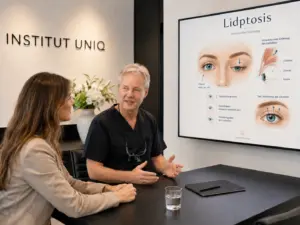
The most common cause is a weakening or loosening of what is known as the levator aponeurosis – that is, the tendon structure that connects the levator muscle to the upper eyelid.
This can be caused by:
- natural ageing processes
- long-term use of contact lenses
- Previous operations
- Inflammation or injuries
- neurological or muscular disorders
- or congenital abnormalities.
Many patients unconsciously compensate for drooping eyelids over the years by raising their forehead or eyebrows.
As a result, the actual cause is often overlooked.
The importance of a nuanced analysis
In Dr Richter’s view, the diagnosis of ptosis is one of the most challenging areas of oculoplastic surgery.
In doing so, he analyses, among other things:
- the exact position of the eyelid margin
- the function of the levator muscle
- the position of the eyebrows
- asymmetric voltage patterns
- Forehead compensation
- Volume proportions of the upper eyelid
- as well as eyelid closure and the tear film.
It is particularly important to distinguish between:
- excess skin
- Brow ptosis
- however, Lidptosis
- Volume loss
- and so-called ‘hollow eyes’.
After all, an incorrect diagnosis can quickly lead to unnatural results or functional problems.
How Dr Richter treats patients
Treatment depends on the cause, severity and function of the levator muscle.
The aim is not simply a ‘higher eyelid’, but a natural, functionally stable and harmonious appearance.
In the most common form of ptosis, the levator aponeurosis is specifically tightened or reattached correctly to the eyelid.
This allows the eyelid margin to be raised without losing its natural mobility.
The following conditions often occur in addition:
- excess skin
- Brow lowering
- or loss of volume.
Dr Richter then tailors the ptosis correction to each individual’s needs by combining it with:
- Upper eyelid blepharoplasty
- Browpexie or brow lift
- as well as autologous fat treatment.
Upper eyelids that are sagging or hollow often benefit more from volume augmentation than from further excision.
Millimetres make all the difference when it comes to a natural look
In ptoosis surgery, both functional and aesthetic adjustments are made in the millimetre range.
Even the slightest differences can determine whether an eye:
- looks natural or has had surgery
- appears symmetrical
- or the eyelid closure remains completely intact.
This is why ptosis surgery is one of the most technically demanding procedures in eyelid surgery.
And even in the hands of highly experienced surgeons, minor follow-up corrections are not uncommon.
Not because the surgery was performed poorly, but because healing, scarring, muscle tension and tissue behaviour can vary from person to person.
His personal approach
Dr Richter never aims for maximum elevation.
His aim is to achieve an anatomically appropriate and natural positioning of the upper eyelid.
Of particular importance to him is:
- not to give the impression of a frightened or fixed gaze
- to maintain the natural eyelid closure
- Assessing asymmetries realistically
- and to respect each person’s individual facial features.
The eyebrow, in particular, plays a key role in this.
The upper eyelid is often just one part of a complex interplay between the eyelid, eyebrow, forehead and volume proportions.
Complex cases or cases involving previous surgery
Many patients only come to see us after they have already undergone surgery.
Eyelids that have undergone multiple previous operations can be particularly challenging from both a functional and anatomical perspective.
Scarring, tissue loss or impaired eyelid mechanics often make correction considerably more difficult.
In such situations, Dr Richter frequently develops bespoke, phased treatment plans in order to:
- Take care to minimise damage to the fabric
- to restore the anatomy step by step
- and to reduce the risk of further complications.
It is precisely here that honest and realistic advice is particularly important.
In eyelid surgery, a good result cannot be forced.
Every single step must be carefully planned and carried out with precision.
Results and objectives
Following successful treatment, the eyes often appear:
- more open
- more relaxed
- more alert
- and more harmonious.
In addition, the field of vision usually improves, and the constant strain on the eyes is significantly reduced.
For Dr Richter, a natural appearance is always the top priority.
A successful result should not look as though it has been surgically altered.
It should look as though the eye has regained its natural openness and calm.
Why experience is crucial
The treatment of ptosis is one of the most precise procedures in oculoplastic surgery.
It requires:
- a thorough understanding of eyelid mechanics
- practical experience
- planning accurate to the millimetre
- and a keen aesthetic sensibility.
It is precisely because even the smallest changes can have a major impact on appearance and function that specialisation is crucial.
Dr Richter’s aim always remains the same:
to achieve a result that looks open, harmonious and natural – without compromising on function.