


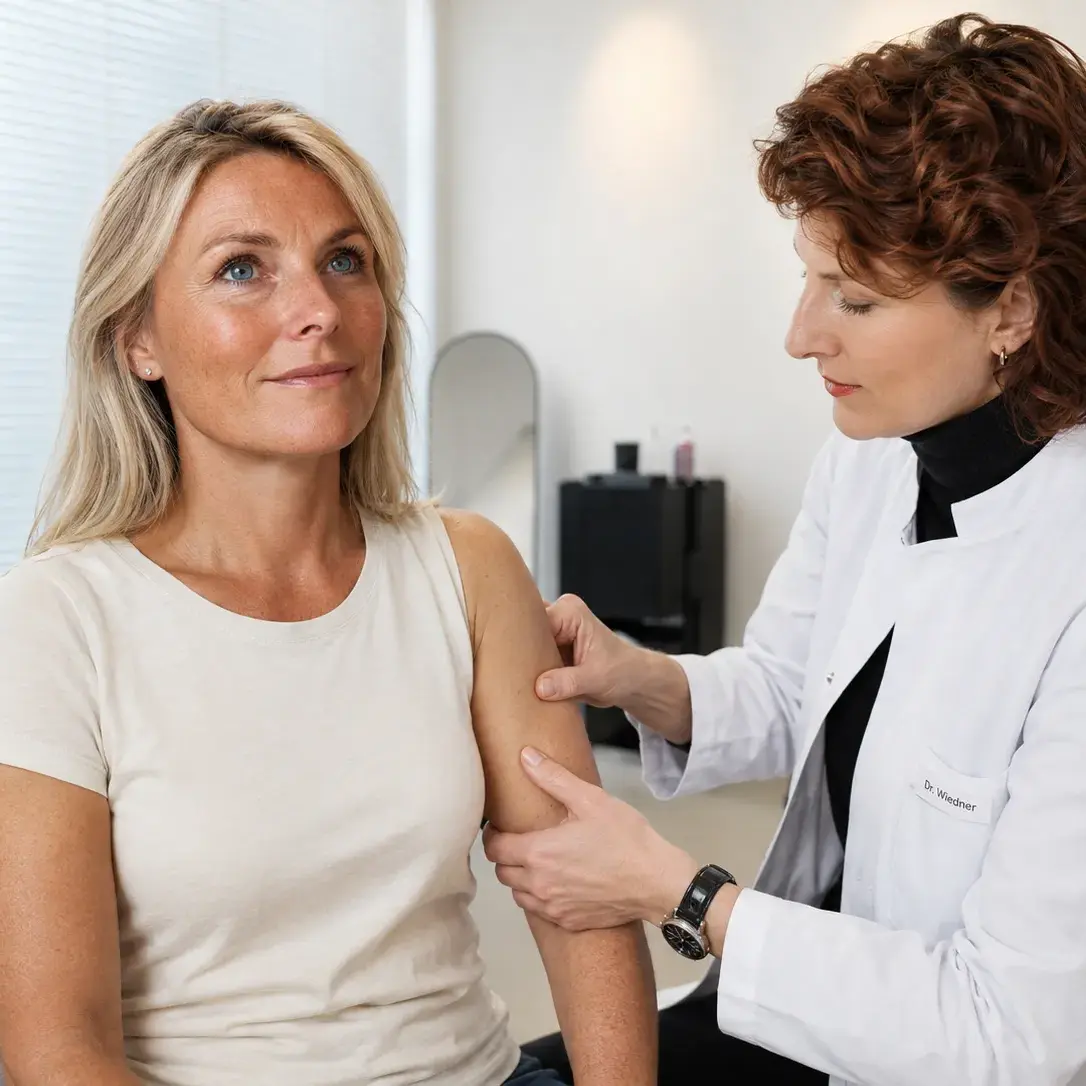
For Dr Wiedner, therefore, modern upper arm lifts are not about achieving the most aggressive tightening possible.
Instead, the focus is on:
- smooth contours
- natural mobility
- long-term stability
- and a texture that feels natural again.
When tissue loses its elasticity
The upper arm region is particularly sensitive to changes in:
- Skin quality
- Tissue elasticity
- weight ratios
- and biological resilience.
Particularly following significant weight loss, it is often not just excess skin that remains.
The internal stability of the tissue is also frequently altered.
Many patients initially try to improve their body contour through exercise alone.
Building muscle can certainly have a positive effect on the body’s shape.
However, this often does not sufficiently tighten skin that has become biologically slack or excess.
This is precisely why Dr Wiedner does not regard an upper arm lift as a purely cosmetic procedure.
For many female patients, it also means:
- greater freedom of movement
- less friction
- greater safety in everyday life
- and a greater sense of physical well-being.
Liposuction alone is often not enough
An important part of the diagnostic process is distinguishing between:
- pure excess fat
- and actual excess skin or tissue.
If the skin is of good quality, liposuction alone may be sufficient in certain cases.
However, particularly where the tissue is significantly sagging, fat removal alone often does not result in sufficient tightening.
In such cases, the following options are available:
- Excess skin remains
- The contours appear uneven
- or continue to decline in the long term.
This is precisely why Dr Wiedner often combines liposuction with a skin tightening procedure.
This frequently results not only in more harmonious contours, but also in a procedure that is significantly gentler on the tissue.
A key advantage of this combination is that it often allows for better preservation of the lymphatic vessels.
In her view, this is particularly important for the upper arms in terms of:
- Healing
- Swelling
- Fabric quality
- Mobility
- and long-term stability.
Different cutting methods and their limitations
Not every upper arm lift requires the same incision.
At the same time, unfortunately, there is no completely ‘invisible’ scar position in cases where there is a significant amount of excess skin.
Essentially, the techniques differ mainly depending on whether the scar:
- is more visible from the front
- or is shifted further back or inwards.
Which position is more appropriate depends, among other things, on:
- excess skin
- Arm shape
- Fabric quality
- and the patient’s personal priorities.
So-called purely axillary or very short incision techniques may initially seem appealing because they promise less visible scarring.
However, in Dr Wiedner’s view, such approaches often fail to produce sufficiently stable or satisfactory long-term results in cases of significant excess skin.
This is precisely why the following also applies here:
Less scarring does not automatically mean a better result.
A slightly longer scar, but one placed in an anatomically appropriate position, can often result in significantly smoother and more harmonious contours in the long term.
Minimally invasive and complementary procedures
Not every patient needs major surgical lifting straight away.
Particularly in cases of mild skin laxity or so-called fine lines, modern radiofrequency treatments can, in selected cases, improve skin quality and tissue firmness.
Fine creases in the upper arm area, in particular, are often caused not only by excess skin, but also by hormonal changes affecting the quality of the skin and connective tissue.
As we age, the collagen structure changes, the skin loses its elasticity and the tissue becomes thinner and softer. This often results in a fine, uneven skin texture that cannot be explained by facelifts alone.
In such situations, complementary procedures such as:
- radio frequency
- Radiofrequency microneedling
- regenerative tissue concepts
- or biological skin enhancement may offer useful additional options.
These procedures can:
- stimulate collagen production
- improve skin quality
- Tighten the skin
- and support the healing process biologically.
However, Dr Wiedner always considers it important to make a realistic assessment of the options available.
Significant excess skin cannot usually be adequately corrected by minimally invasive procedures alone.
This is precisely why she does not view conservative, minimally invasive and surgical procedures as mutually exclusive.
Rather, she sees them as different tools that can be combined effectively depending on tissue quality, hormonal status and individual anatomy.
Lymphatic system, sensitivity and tissue protection
The upper arm region contains sensitive lymphatic and nerve networks, which must be taken into particular account during surgical planning.
That is precisely why Dr Wiedner attaches great importance to:
- tissue-preserving dissection
- controlled voltage
- careful scar management
- and treatment that is as gentle as possible on the lymphatic system.
After all, long-lasting, beautiful results are not achieved through streamlining alone.
The key factors are:
- good mobility
- sturdy fabrics
- smooth transitions
- and a natural integration of the contours into the overall body silhouette.
The importance of fabric quality
Particularly following weight loss or repeated fluctuations in weight, the tissue often has significantly reduced elasticity.
That is why Dr Wiedner is increasingly incorporating regenerative approaches into her body-shaping strategies.
These include, in particular:
- Autologous fat transfer
- regenerative tissue concepts
- Radiofrequency procedures
- as well as supporting the healing process naturally.
This is not about artificial change.
Rather, the focus is on:
- better fabric quality
- smoother transitions
- long-term stability
- and biologically harmonious healing.
A natural look rather than an overly tight appearance
Dr Wiedner deliberately adopts a calm and anatomically oriented approach.
Their aim is not to tense their upper arm as much as possible.
The focus is rather on:
- smooth contours
- natürliche Beweglichkeit
- long-term stability
- and an arm that feels natural and right again.
In her view, the most challenging aspect of modern upper arm surgery is not achieving maximum tightening.
It lies in restoring a natural balance between tissue quality, function and body proportions.