



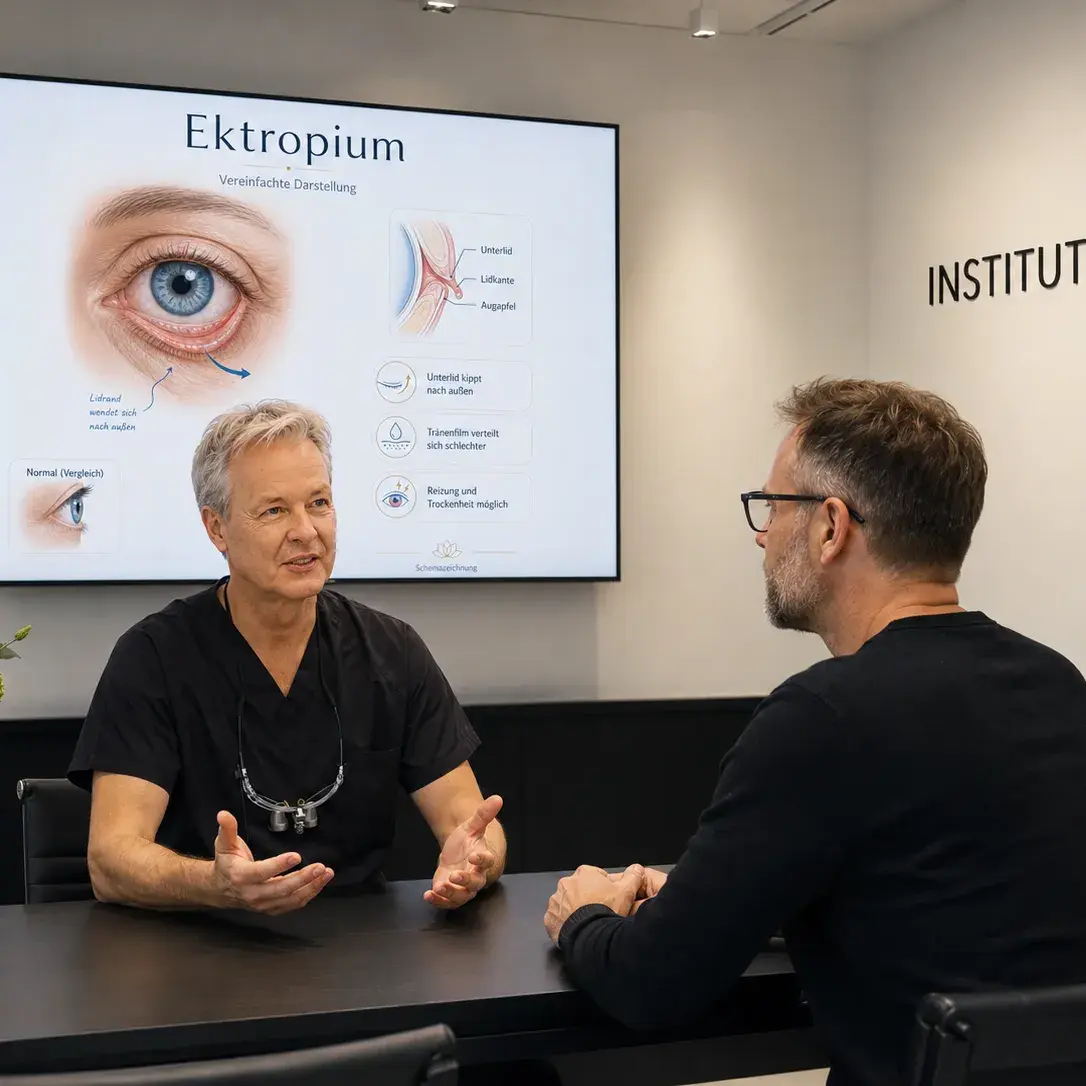
In practical terms, however, the burden can be considerable.
This is because, in the long term, the malposition affects not only the appearance of the eye area, but also the protection of the cornea, the lubrication of the eye and the overall function of the eyelid.
For Dr Richter, the treatment of ectropion is therefore one of the most challenging areas of oculoplastic surgery.
It is not simply a matter of ‘pulling the eyelid back’, but of restoring stability, function and a natural appearance.
Why ectropion occurs
Ectropion is usually not caused by a single factor, but by a combination of various anatomical changes.
Age-related tissue laxity, excess skin, scarring or instability of the lateral eyelid suspension are particularly common factors.
As we age, the lower eyelid loses its firmness. At the same time, the delicate supporting structures that stabilise the eyelid can weaken.
Individual anatomical factors also play a role.
For example, some people naturally have less bony support for the lower eyelid or what is known as a ‘negative vector’, where the eyeball protrudes more prominently in relation to the bony eye socket.
Previous surgery, scarring or aggressive skin removal can also significantly affect the balance of the lower eyelid.
This is precisely why ectropion often looks similar on the surface, even though the underlying causes may be completely different.
And it is precisely these differences that ultimately determine how it should be treated.
The importance of a precise analysis
For Dr Richter, therefore, treatment always begins with a very thorough examination.
In doing so, he analyses, among other things:
- the horizontal tension of the lower eyelid
- the stability of the lateral eyelid suspension
- the quality and length of the skin
- possible scarring in deeper layers
- the function of eyelid closure
- as well as the influence of individual anatomy.
It is particularly important to distinguish between:
- a skin problem affecting the so-called anterior lamella
- a structural weakness in deeper tissue layers
- instability of the lateral eyelid suspension
- or a combination of several factors.
This is precisely where one of the greatest challenges of eyelid surgery lies.
This is because ectropion cannot be treated using a standardised technique.
The underlying cause must be understood before meaningful reconstruction is possible.
How Dr Richter treats patients
Treatment is always tailored to the underlying cause.
If there is not enough skin, the lower eyelid must be lengthened again.
Whenever anatomically appropriate, Dr Richter prefers to use tissue from the immediate vicinity.
In particular, skin and tissue from the midface often match the recipient site much better in terms of colour, texture and firmness than traditional skin grafts.
This often results in more harmonious and natural-looking results.
Although skin grafts – for example, from the ear – may be necessary, in his view they are not always the most elegant solution.
If the lower eyelid has become too loose overall, it is specifically tightened and stabilised.
The lateral eyelid suspension plays a key role in this.
Depending on the findings, the following will be carried out:
- gentle stabilisation through canthopexy
- or structural reconstruction via canthoplasty.
If deeper layers of tissue are also affected, it may be necessary to structurally reinforce the eyelid or to specifically release scar tissue.
The aim remains the same in all cases:
The lower eyelid should sit firmly against the eye once again, providing reliable protection whilst looking natural.
Form and function go hand in hand
For Dr Richter, function and aesthetics are inextricably linked when it comes to the eyelids.
An eyelid may look perfectly normal on the outside – yet still cause functional problems.
Conversely, whilst aggressive correction may create tension in the short term, it can at the same time impair natural facial expression or the ability to close the eyelids.
That is why visual correction is never his sole priority.
The key is to restore functional balance.
A good result means:
- Stable lip position
- gentle closing of the eyelids
- Protection of the cornea
- reduced irritation
- and a natural look.
It is precisely this combination that makes ectropion surgery so challenging.
Previous operations and complex cases
Many patients only come to see us after they have already undergone surgery.
Eyelids that have undergone multiple previous operations can be highly complex, both anatomically and functionally.
Scars, tissue loss, tension, previous skin excisions or impaired eyelid function often significantly alter the natural anatomy.
In such situations, it is not always possible to achieve the best possible result in a single procedure.
That is why Dr Richter often develops personalised, step-by-step programmes.
These allow:
- a step-by-step reconstruction
- less tissue damage
- realistic recovery processes
- and more stable results in the long term.
Particularly in complex cases, he sees an important part of his role as setting realistic expectations and guiding patients safely through this process.
A good outcome cannot be forced in eyelid surgery.
Every single step must be carefully planned and carried out with precision.
Results and objectives
Following successful treatment, the lower eyelid lies firmly against the eye once again.
Tearing is usually significantly reduced, irritation of the eye’s surface subsides, and the eye is once again protected more effectively.
At the same time, the eye area often appears more relaxed, balanced and natural.
For Dr Richter, striking the right balance is always the top priority.
It is not maximum tension, but functional stability and a natural look that determine the quality of the result.
Why the first operation is crucial
In the field of eyelid surgery in particular, Dr Richter believes that a simple yet important principle applies:
It is best to ensure that complex corrective procedures are not required in the first place.
Choosing an experienced specialist surgeon for the initial procedure significantly reduces the risk of functional problems and the need for subsequent revisions – even though risks can never be completely ruled out.
After all, when it comes to the eyelids in particular, it is often a matter of millimetres that determines function, expression and long-term stability.
And ultimately, one realisation remains particularly important:
You only have one face.
That is why choosing a surgeon requires particular care and responsibility.
Conclusion
The treatment of ectropion requires far more than a simple eyelid operation.
It calls for:
- a thorough understanding of eyelid mechanics
- Experience in functional and reconstructive surgery
- detailed analysis
- and a tailor-made plan.
It is particularly in complex cases or where previous surgery has taken place that the importance of specialisation, experience and restraint becomes apparent.
Dr Richter’s aim remains unchanged:
Not to make as many changes as possible – but to restore the function, protection and natural harmony of the lower eyelid.