



It is precisely for this reason that Dr Richter does not regard upper eyelid surgery as a standardised procedure for removing excess skin.
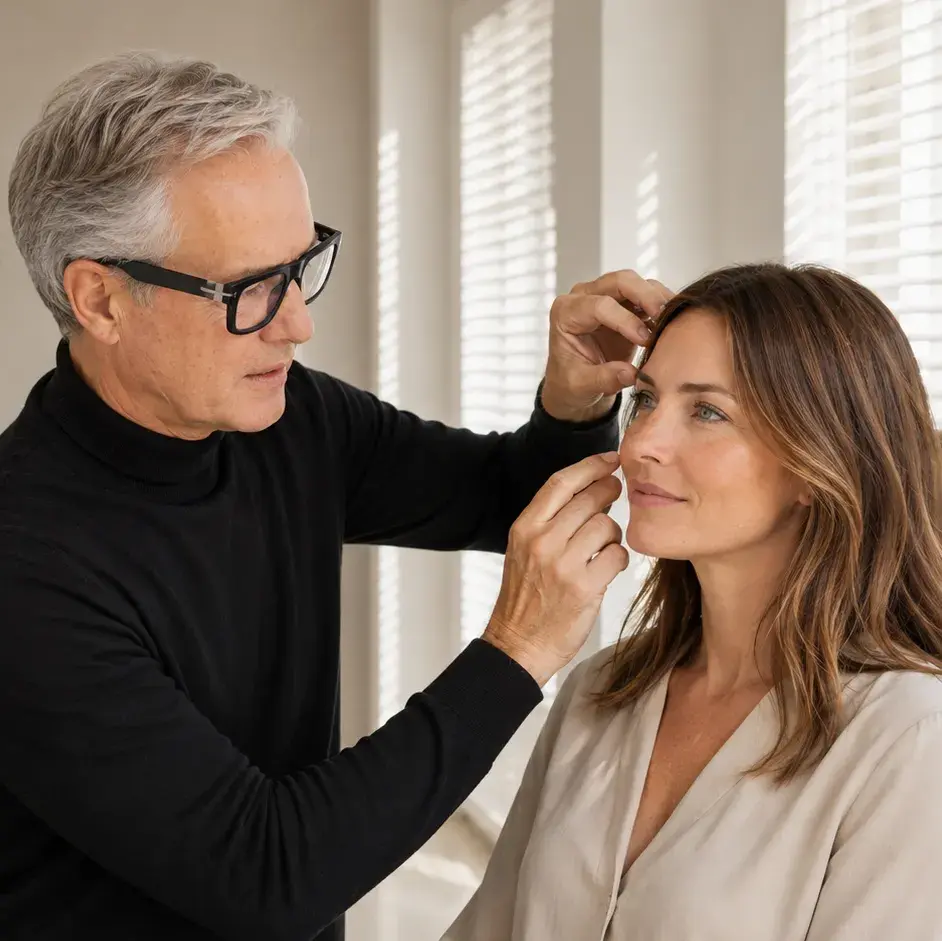
For him, it is rather the precise anatomical reorganisation of a highly sensitive functional and aesthetic system.
The upper eyelid is not just made up of skin.
It is a complex interplay of:
- Skin
- Muscle
- Fat
- Volume
- Fine supporting structures
- Eyebrow
- Forehead tension
- and eyelid mechanics.
Every change therefore affects not only the appearance but also the overall dynamics of facial expression.
Why this procedure is so special
When correctly indicated and performed with precision, upper eyelid blepharoplasty is, in Dr Richter’s view, one of the most effective and, at the same time, most elegant procedures in facial surgery.
Hardly any other treatment can achieve such a marked effect with comparatively little surgical effort.
The eyes often appear:
- More open
- More clear-headed
- More relaxed
- and more refreshed.
Those around them often do not notice any visible ‘surgery’.
People simply appear fresher, more alert and more harmonious.
This is precisely what Dr Richter sees as the true measure of a successful upper eyelid correction.
Not change for change’s sake – but the restoration of balance.
His aesthetic standards
For Dr Richter, the focus is not on achieving the greatest possible change.
His aim is to fully preserve the patient’s individual eye shape, natural expression and personality.
In his view, a good result can be recognised by the fact that,
- That it does not look as though surgery has been performed
- That the individual shape of the eye is preserved
- That the eye does not appear round or taut
- and that a person’s identity remains intact.
For him, the so-called ‘round eye’ is one of the most common – and at the same time preventable – complications following improper upper eyelid surgery.
This not only alters the shape of the eye, but often the entire facial expression as well.
The natural look is lost.
This is precisely why Dr Richter adopts a decidedly conservative approach that preserves the natural structure.
The importance of an individual analysis
For Dr Richter, successful upper eyelid surgery does not begin with the operation itself, but with a detailed analysis.
This is not just about excess skin.
The key question is:
Why does the upper eyelid appear heavy?
This is because several factors often come into play at the same time:
- Excess skin
- Drooping eyebrows
- Loss of volume
- Ptosis
- or changes in forehead tension.
That is precisely why Dr Richter makes a point of setting aside plenty of time for consultations.
Looking at older photographs is often an important part of this process.
For him, the best reference is not some arbitrary ideal of beauty, but the patient’s own natural, younger anatomy.
Restraint rather than trends
Dr Richter deliberately rejects deliberate changes to facial contours, such as so-called ‘fox eyes’ or ‘cat eyes’.
In his view, such approaches do not aim to restore natural anatomy, but rather to artificially alter facial features.
This can:
- Lead to an unnatural appearance
- Alter a person’s individual identity
- Cause functional problems relating to eyelid tension
- and, in the long term, impair the eye’s natural balance.
He regards many of these concepts in particular as short-lived aesthetic trends.
His philosophy is different:
Naturalness is timeless.
Modern upper eyelid surgery is all about preserving tissue
For Dr Richter, a key aspect of modern upper eyelid surgery is preserving as much of the natural structure as possible.
Many undesirable outcomes are not caused by insufficient surgery, but by overly aggressive resection.
Removing too much skin, unnecessary fat removal or the loss of natural volume proportions often lead to:
- Drooping upper eyelids
- Sharp transitions
- Loss of expression
- or an artificial appearance.
That is why Dr Richter adopts a tissue-preserving and tailored approach.
In doing so, he takes into account, amongst other things:
- Volume proportions of the upper eyelid
- Fat distribution
- Muscle tone
- Brow position
- as well as the quality of the skin and supporting structures.
Upper eyelids that have recently sagged or are ‘hollow’ often benefit more from volume stabilisation or autologous fat grafting than from further excision.
Enhanced surgical precision
In Dr Richter’s view, the quality of modern upper eyelid surgery lies in the precise combination of finely tuned techniques.
These include, amongst others:
- Selective tissue preservation
- Targeted treatment of fat and volume
- Integration of the eyebrow
- Internal stabilisation techniques
- as well as the identification of complex anatomical findings such as excess ROOF tissue.
It is precisely this nuanced planning that goes far beyond traditional skin removal.
After all, the upper eyelid must never be considered in isolation.
It forms part of a complex interplay between the eyelid, eyebrow, forehead and midface.
Function and aesthetics go hand in hand
For Dr Richter, function and aesthetics are inextricably linked when it comes to the eyelids.
An upper eyelid may appear smooth on the outside yet still present functional problems.
That is why he pays particular attention to:
- To maintain the natural eyelid closure
- To avoid placing any tension on the surface of the eye
- Not to alter the facial expression
- and to preserve the natural movement of the eye area.
In his view, a successful result does not look ‘contrived’.
It looks natural.
Results and Objectives
Following successful upper eyelid surgery, many patients report:
- That they look more alert again,
- Seem more refreshed,
- and feel more like themselves again.
Not:
‘I look different.’
But rather:
‘I look just like I used to – only fresher.’
For Dr Richter, this is precisely what defines the true quality of a successful upper eyelid correction.
Why experience is crucial
Precisely because the changes to the upper eyelid often appear subtle, the complexity of this procedure is frequently underestimated.
Yet it is often a matter of millimetres that makes all the difference:
- Naturalness
- Function
- Expression
- and long-term stability.
Choosing an experienced, specialist surgeon significantly reduces the risk of functional problems and the need for subsequent revision surgery.
After all, when it comes to the eyes in particular:
You only have one face.
And that is why every decision in this area deserves particular care and responsibility.
His personal ambition
Dr Richter does not see his role as changing people’s faces.
His aim is to restore expression, clarity and natural harmony.
With respect for:
- Anatomy
- Function
- Personality
- and individuality.
A successful result shouldn’t stand out.
It should be convincing – precisely because it seems so natural.