



Why an entropium is formed
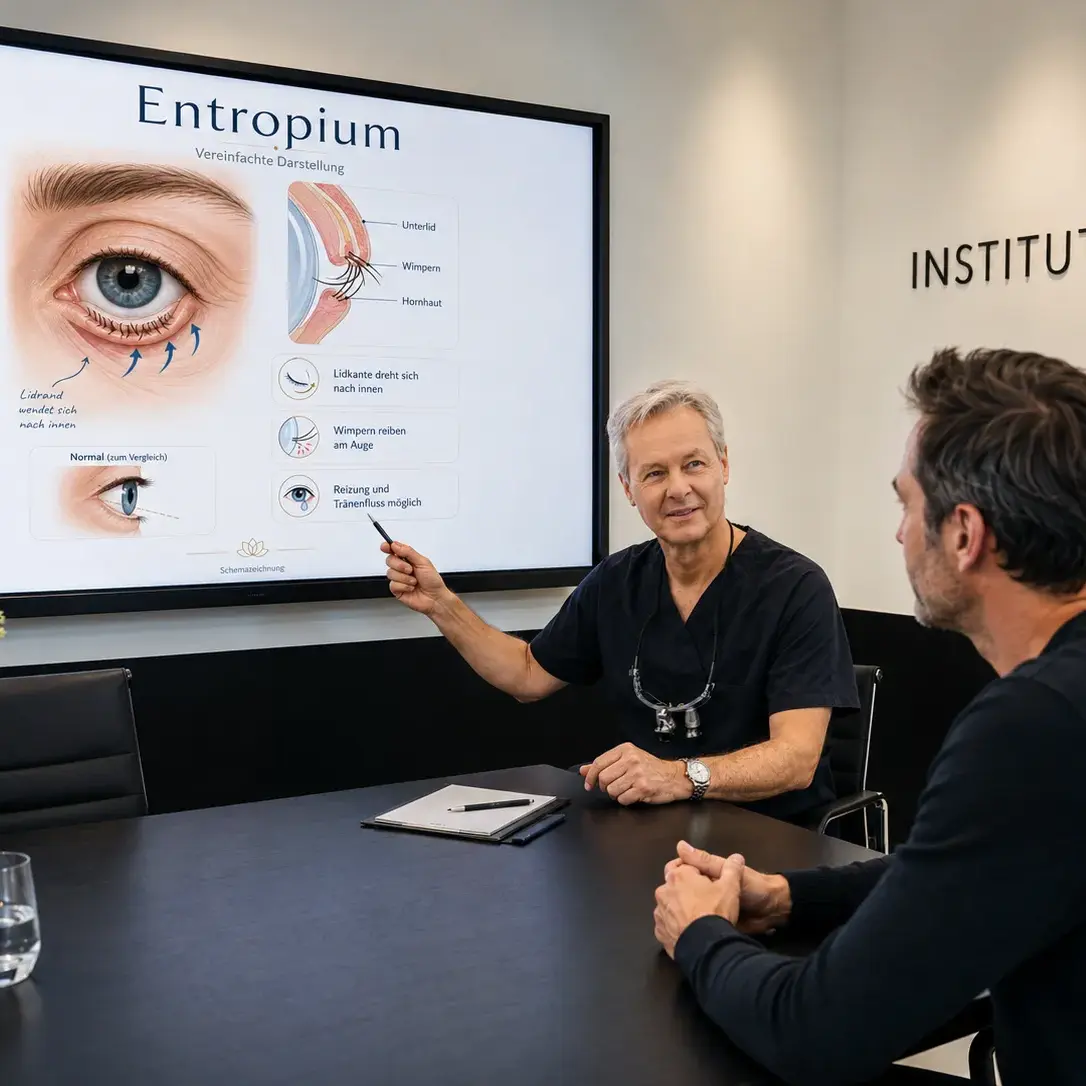
As we age, the lower eyelid loses its elasticity. At the same time, muscle fibres and supporting structures shift. As a result, the eyelid tilts increasingly inwards.
In addition, scarring, chronic inflammation, previous surgery or so-called cicatricial changes can shorten the internal structure of the eyelid and exacerbate the misalignment.
This is precisely why entropion often looks similar on the outside, even though the underlying mechanisms may be completely different.
And it is precisely these differences that determine which treatment will be successful in the long term.
The importance of a precise analysis
For Dr Richter, treatment always begins with a very thorough functional examination.
During this, he analyses, amongst other things:
- the horizontal tension of the lower eyelid
- the stability of the lateral eyelid suspension
- the function of the lower eyelid retractors
- the dynamics of the eyelid muscles
- possible scarring
- as well as irritation of the cornea and the surface of the eye.
Why does the eyelid turn inwards?
For it is only once the actual cause has been understood that a stable, long-term correction can be achieved.
This is precisely where one of the greatest challenges of oculoplastic surgery lies.
Entropion can appear very similar on the surface – yet have completely different underlying causes.
How Dr Richter treats patients
Treatment always depends on the cause, severity and functional situation.
Conservative measures such as eye ointments, lubricating therapy or taping of the lower eyelid may provide temporary relief. In certain cases, botulinum toxin injections may also be appropriate.
In most cases, however, surgical correction is necessary to stabilise the eyelid permanently.
Depending on the findings, Dr Richter combines different techniques:
- horizontal blepharoplasty
- Refixation or tightening of the lower eyelid retractors
- Correction of muscle displacement
- Treatment of scarring lesions
- as well as stabilisation of the lateral canthus by canthopexy or canthoplasty.
What matters here is not the individual technique, but the right combination.
It is precisely in this respect, in his view, that the experience of a specialist in oculoplastic surgery comes to the fore:
The anatomy of the lower eyelid must be understood in three dimensions, both functionally and aesthetically.
Function and naturalness go hand in hand
For Dr Richter, correcting vision is never the sole priority.
A good result means:
- Stable lid function
- Protection of the cornea
- complete eyelid closure
- harmonious eyelid contour
- and a natural look.
When it comes to the eyelids in particular, a matter of millimetres often makes all the difference in terms of function and aesthetics.
That is why precise analysis, experience and a cautious approach are crucial.
The aim is not to achieve maximum tension, but to restore a natural balance.
Complex cases or those involving previous surgery
Many patients only come to see us after they have already undergone surgery.
Eyelids that have undergone multiple previous operations can be particularly challenging, both anatomically and functionally.
Scarring, tissue loss or impaired eyelid mechanics often alter the natural anatomy significantly.
In such situations, Dr Richter frequently develops bespoke, phased treatment plans.
These allow for:
- a step-by-step reconstruction
- less tissue damage
- realistic recovery processes
- and more stable results in the long term.
A good outcome cannot be forced in eyelid surgery.
Every single step must be carefully planned and carried out with precision.
Conclusion
The treatment of entropion is one of the most technically demanding procedures in oculoplastic surgery.
It requires:
- a thorough understanding of eyelid mechanics
- accurate diagnosis
- surgical experience
- and a tailor-made plan.
It is precisely in complex cases or where previous surgery has taken place that the importance of specialisation and an understanding of anatomy becomes apparent.
Dr Richter’s aim remains unchanged:
Not to alter as much as possible – but to restore the lower eyelid’s protection, function and natural harmony.